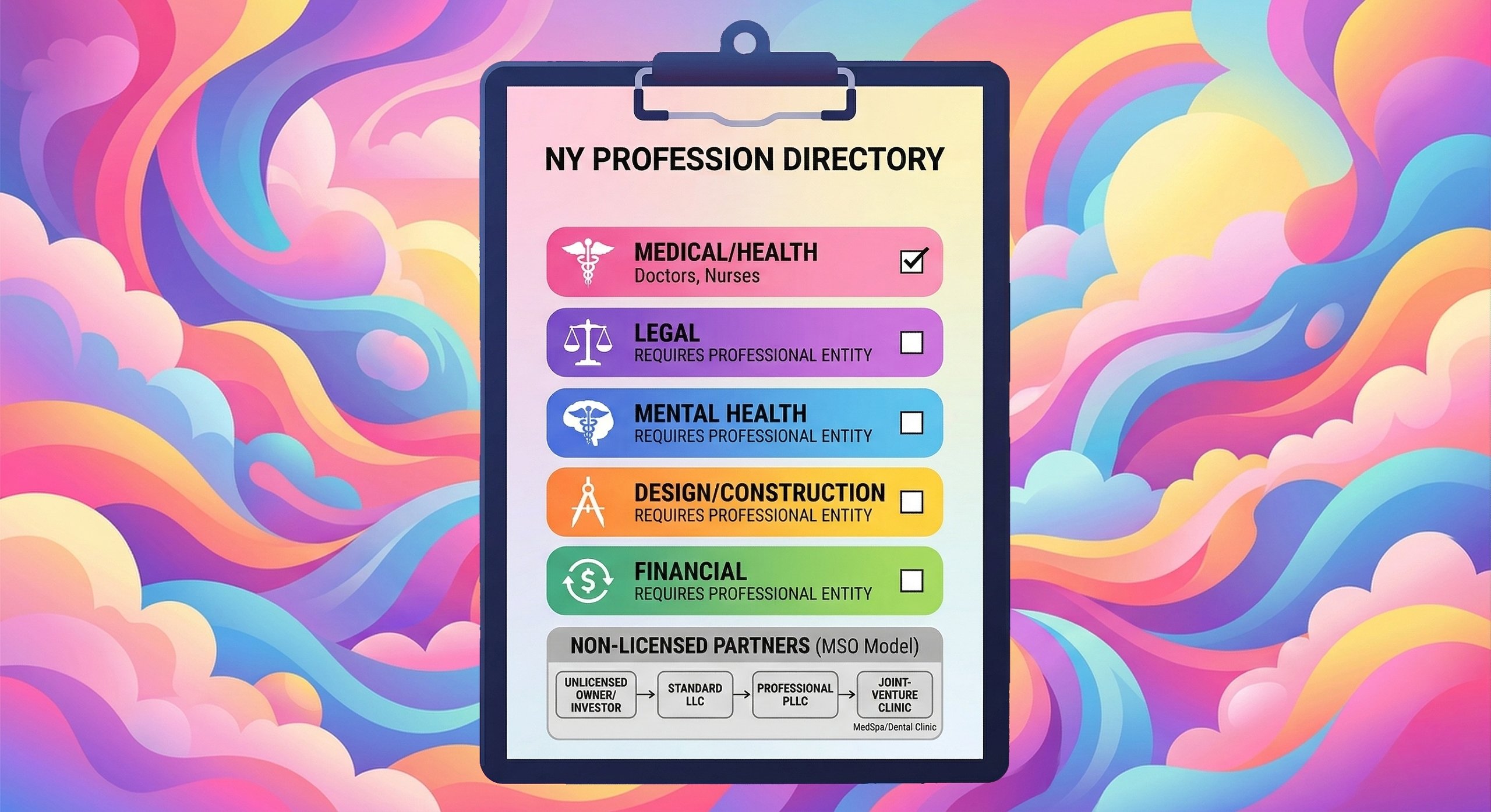
If you are planning to open a private practice or professional firm in New York and want personal liability protection, you cannot simply form a standard Limited Liability Company (LLC) or Business Corporation (Inc.). Under New York law, licensed professionals must form a New York PLLCs or other specialized professional entities to offer their services to the public while protecting their personal assets.
This page serves as a definitive 2026 directory of the New York professionals that require a PLLC, PC, DPC, or LLP. If your specific profession is on this list, operating through a standard LLC or corporation is a violation of state law that can lead to severe fines, license suspension, and even imprisonment.
The “Corporate Practice of Professions” Doctrine
New York strictly enforces the “Corporate Practice of Professions” doctrine. This legal framework ensures that only individuals who are licensed, regulated, and professionally accountable to the state can own and manage a business that provides professional services. The doctrine prevents unlicensed individuals or business investors from prioritizing corporate profits over professional ethics and patient care. (For information on how unlicensed investors can legally partner with professionals, see the MSO Model section below.)
A Note on Sole Proprietorships and Partnerships: It is legally permissible to operate your practice as a basic sole proprietorship or a general partnership. However, doing so is highly discouraged because it leaves your personal assets (like your home and personal savings) completely exposed to business debts, lease liabilities, and lawsuits.
If you want to protect your personal assets by forming a formal business entity, Title 8 of the New York Education Law dictates that you must form a specific professional entity. These include:
- PLLC: Professional Service Limited Liability Company
- PC: Professional Service Corporation
- LLP: Registered Limited Liability Partnership
- DPC: Design Professional Corporation
Directory: Which Professions Require a Professional Entity in NY?
Below is the complete, categorized list of the specific professionals who must obtain state pre-approval and form a professional entity to legally operate a protected practice in New York State. If the practitioner’s title differs from the statutory license category, the official NYSED profession is listed in parentheses.
1. Healthcare, Medicine & Allied Health
We are frequently asked, “Do physicians need a PLLC in New York?” or “Can a nurse open a standard LLC?” The answer is clear: Medical and allied health professionals face the strictest corporate practice regulations. To bill insurance and protect themselves from liabilities, these practitioners must use a New York PLLC, PC, or LLP.
- Acupuncturists (Acupuncture)
- Athletic Trainers
- Audiologists (Audiology)
- Chiropractors (Chiropractic)
- Clinical Laboratory Technicians
- Clinical Laboratory Technologists
- Cytotechnologists
- Dental Assistants (Dental Assisting)
- Dental Hygienists (Dental Hygiene)
- Dentists (Dentistry)
- Dietitians/Nutritionists (Dietetics/Nutrition)
- Histological Technicians
- Licensed Practical Nurses (LPN) (Licensed Practical Nursing)
- Massage Therapists (Massage Therapy)
- Medical Physicists (Medical Physics)
- Midwives (Midwifery)
- Nurse Practitioners (NP)
- Occupational Therapists (OT) (Occupational Therapy)
- Occupational Therapy Assistants (OTA)
- Ophthalmic Dispensers (Ophthalmic Dispensing)
- Optometrists (Optometry)
- Perfusionists (Perfusion)
- Pharmacists (Pharmacy)
- Physical Therapists (PT) (Physical Therapy)
- Physical Therapist Assistants (PTA)
- Physicians (MD or DO) (Medicine)
- Podiatrists (Podiatry)
- Polysomnographic Technologists (Polysomnographic Technology)
- Registered Physician Assistants (RPA)
- Registered Professional Nurses (RN) (Registered Professional Nursing)
- Registered Specialist Assistants
- Respiratory Therapists
- Respiratory Therapy Technicians
- Speech-Language Pathologists (Speech-Language Pathology)
- Veterinarians (Veterinary Medicine)
- Veterinary Technologists/Technicians (Veterinary Technology)
2. Mental Health & Behavioral Sciences
Clients regularly ask us, “Can LCSWs use an LLP in NY?” or “Can a therapist practice with an LLC?” Because the mental health and behavioral fields are heavily regulated by NYSED, forming a proper professional entity is absolutely mandatory for private practices.
- Certified Behavior Analyst Assistants
- Creative Arts Therapists (LCAT) (Creative Arts Therapy)
- Licensed Behavior Analysts
- Licensed Clinical Social Workers (LCSW) (Licensed Clinical Social Work)
- Licensed Master Social Workers (LMSW) (Licensed Master Social Work)
- Marriage and Family Therapists (LMFT) (Marriage and Family Therapy)
- Mental Health Counselors (LMHC) (Mental Health Counseling)
- Psychoanalysts
- Psychologists (Psychology)
3. Design, Engineering & Construction
Design professionals typically form NY PLLCs or LLPs. Furthermore, certain design professions are eligible to form a specialized entity called a Design Professional Corporation (DPC), which allows for minority ownership by unlicensed individuals under very strict conditions.
- Architects (Architecture)
- Interior Designers (Interior Design)
- Land Surveyors (Land Surveying)
- Landscape Architects (Landscape Architecture)
- Professional Engineers (PE) (Professional Engineering)
- Professional Geologists (Geology)
4. Financial, Legal & Official Reporting
While attorneys are regulated by the Appellate Division of the Supreme Court rather than NYSED, they are still subject to the corporate practice doctrine alongside financial and reporting professionals, meaning standard LLCs and corporations are prohibited.
- Attorneys at Law (Law)
- Certified Public Accountants (CPA) (Certified Public Accountancy)
- Certified Shorthand Reporters (Certified Shorthand Reporting)
- Public Accountants (PA) (Public Accountancy)
Note: If you do not see your specific license listed above, or you wish to verify statutory classifications, you can review the official NYSED Office of the Professions directory.
Multi-Profession Practices: Can Different Professionals Partner Up?
Many professionals want to open multi-disciplinary practices (for example, a physical therapist and an acupuncturist partnering to open a wellness clinic). New York has strict rules regarding whether different licensed professionals can co-own the same business entity:
- Professional Corporations (PCs): PCs generally cannot have owners with different professions. All shareholders in a standard PC must be licensed in the exact same profession.
- Design Professional Corporations (DPCs): DPCs are specialized entities strictly for the design fields (Architecture, Engineering, Land Surveying, Landscape Architecture, and Geology). DPCs can be multi-profession, provided the offered services are strictly limited to those recognized design professions. Furthermore, DPCs offer a rare exception to the general ownership rules: they can have less than 25% of their ownership held by non-licensed individuals (such as an office manager or CFO), provided specific corporate governance requirements are met.
- PLLCs and LLPs: These entities generally allow for multi-profession ownership, provided that all owners are licensed professionals and the entity legally offers the services for which the owners are licensed.
The “Strict Prohibition” Exceptions for Co-Ownership:
Even within PLLCs and LLPs, New York law absolutely forbids multi-profession co-ownership if the entity will practice any of the following specific professions. If your practice involves any of these, all co-owners must share the exact same license:
- Certified Behavior Analyst Assistants
- Creative Arts Therapists (LCAT)
- Dentists
- Licensed Behavior Analysts
- Licensed Clinical Social Workers (LCSW)
- Marriage and Family Therapists (LMFT)
- Mental Health Counselors (LMHC)
- Physicians (MD or DO)
- Psychoanalysts
- Veterinarians
The Single-Owner Exception (For PCs and PLLCs):
There is a major exception to these strict rules. If the professional entity has only one owner, that PLLC or PC can be legally set up to practice all of the professions that the single owner is individually licensed in. For example, if a single individual is dual-licensed as both a Physician (MD) and an Acupuncturist, their single-member PLLC or PC can legally provide both medical and acupuncture services.
Partnering with Unlicensed Individuals (The MSO Model)
Because of the corporate practice rules, unlicensed individuals—including business investors, marketing experts, or even a professional’s spouse or family member—cannot own any percentage of a standard New York professional entity (PLLC or PC, with the sole exception of a minority interest in a DPC).
To legally navigate this, many practices use the Management Services Organization (MSO) model. This is the industry-standard structure used by some of the largest urgent care chains and primary care groups in New York. Under this model:
- The Professional Entity (PLLC/PC) is owned 100% by the licensed professional and provides all clinical care.
- The MSO (Standard LLC or Business Corporation) is owned by the unlicensed partners, spouse, or investor group. The MSO provides branding, office space, non-clinical staffing, and billing in exchange for a management fee.
Common MSO Application: MedSpas. Modern MedSpas often use this dual-entity approach. The MSO (the Corporation or LLC) handles the “Beauty & Appearance Enhancement” side (salon/spa services that do not require NYSED licensing), while the PLLC handles medical-grade treatments (like Botox or laser therapy) performed by licensed clinicians.
Exceptions: Which Licensed Jobs Do NOT Need a Professional Entity?
One of the most common myths in New York business law is that “if you need a license, you need a PLLC.” This is false. The requirement to form a professional entity generally only applies to professions licensed under Title 8 of the NYSED Education Law (plus attorneys).
If your specific profession is not on the list above, you likely do not need to form a professional entity, even if you hold a state or municipal license. The following professionals are perfectly legal to operate through a standard LLC or Business Corporation:
- Skilled Trades & Home Services: Plumbers, electricians, and home inspectors are heavily licensed (either by the Department of State or local municipalities), but they do not fall under the strict corporate practice doctrine. They can use standard LLCs or corporations.
- Beauty & Appearance Enhancement: Cosmetologists, estheticians, nail specialists, hair stylists, and barbers are licensed by the NY Department of State (NYDOS) and can freely form standard LLCs or corporations to operate their salons or spas.
- Real Estate Professionals: Real estate brokers and salespersons are licensed by NYDOS and typically operate through standard LLCs.
- Other State-Licensed Roles: Private investigators, notary publics, and talent agents are all licensed or commissioned by the state, but do not require a PLLC.
- Coaches & Consultants: Because “coaching” (e.g., life coaches, business coaches) is not a state-licensed medical or therapeutic practice, coaches do not form PLLCs. *(Note: If you are a Licensed Clinical Social Worker who also offers coaching, you must be incredibly careful not to blur the lines of your licensed practice).*
- Bookkeepers and Unlicensed Accountants: Only Certified Public Accountants (CPAs) and Public Accountants (PAs) require professional entities. General bookkeepers and tax preparers can use standard LLCs.
Did You Accidentally Form a Standard LLC?
If your profession is on the required list above and you are currently operating your practice through a standard LLC, you are in violation of New York law. To be compliant, you’ll need to form a New York PLLC.
After the PLLC is formed, you’ll have to decide what to do with the LLC. Dissolving the LLC to start over can result in the loss of your business bank accounts, your Employer Identification Number (EIN), and your credentialing. Fortunately, New York allows for a legal remedy. While you cannot simply “convert” an LLC into a PLLC, you can execute a Statutory Merger to seamlessly transition your practice without losing your EIN or operational continuity. Learn exactly how this works in our guide: How to Convert an LLC to a PLLC via Statutory Merger.
New York Professional Entity Directory: Frequently Asked Questions (FAQ)
What is the “Corporate Practice of Professions” doctrine?
It is a New York legal framework that requires specific licensed professionals to form specialized business entities (like a PLLC or PC) instead of standard LLCs or corporations. This law ensures that business and clinical decisions are made by licensed professionals who are accountable to the state, preventing unlicensed corporate investors from prioritizing profit over patient or client care.
If I have a state license for my job, do I automatically need a PLLC?
No. This is a common misconception. The requirement generally only applies to specific professions licensed under Title 8 of the NY Education Law, as well as attorneys. Many other state-licensed professionals—such as real estate brokers, plumbers, and cosmetologists—are perfectly legal to operate using standard LLCs.
What happens if I accidentally formed a standard LLC for my licensed practice?
Operating a licensed practice through a standard LLC is a violation of New York law that can result in fines and the voiding of your client contracts. However, you do not necessarily need to dissolve the business and lose your EIN. You can execute a “Statutory Merger” to legally convert your standard LLC into a compliant PLLC.
Can I form a PLLC with a partner who has a different professional license?
It depends. Generally, PLLCs and LLPs allow multi-profession ownership if the business provides the services for which all owners are licensed. However, New York strictly forbids multi-profession co-ownership for certain fields, including Physicians, LCSWs, Dentists, and Mental Health Counselors. If your practice involves these professions, all co-owners must share the exact same license.
I hold two different professional licenses. Can my PLLC offer both services?
Yes. There is a “Single-Owner Exception.” If a PLLC or PC is owned by exactly one person, that business entity can legally be set up to provide all the services that the single owner is individually licensed to practice (e.g., someone dual-licensed as an MD and an Acupuncturist).
Can my spouse or an unlicensed investor own a percentage of my practice?
Because of corporate practice rules, unlicensed individuals generally cannot own any percentage of a New York PLLC or PC. However, many practices legally partner with unlicensed individuals using the Management Services Organization (MSO) model.
What is the Management Services Organization (MSO) model?
The MSO model is a legal structure where a licensed professional owns 100% of the clinical PLLC, while an unlicensed partner or investor owns a standard LLC (the MSO). The MSO handles the business side—such as branding, office space, and billing—and charges the PLLC a management fee. This is the standard structure used by major urgent care chains and MedSpas.
What is a Design Professional Corporation (DPC)?
A DPC is a specialized corporate entity strictly for design fields like Architecture, Engineering, and Land Surveying. Unlike standard professional entities, a DPC offers a rare exception to the ownership rules: it can have less than 25% of its ownership held by non-licensed individuals (such as an office manager or CFO), as long as specific corporate governance rules are met.
Can I just operate as a sole proprietor instead of forming a PLLC?
Yes, it is legally permissible to operate as a sole proprietorship or a general partnership without forming a professional entity. However, doing so is highly discouraged because it offers zero personal liability protection. Your personal assets—including your home and personal bank accounts—would be completely exposed to business debts and lawsuits.
Navigating New York’s strict corporate practice laws can be overwhelming. If you need help forming a legally compliant professional entity, or merging an existing LLC, our experienced NYC business attorneys are here to help.
No thoughts on "Definitive Directory of New York Professions Requiring a PLLC, PC, DPC, or LLP."